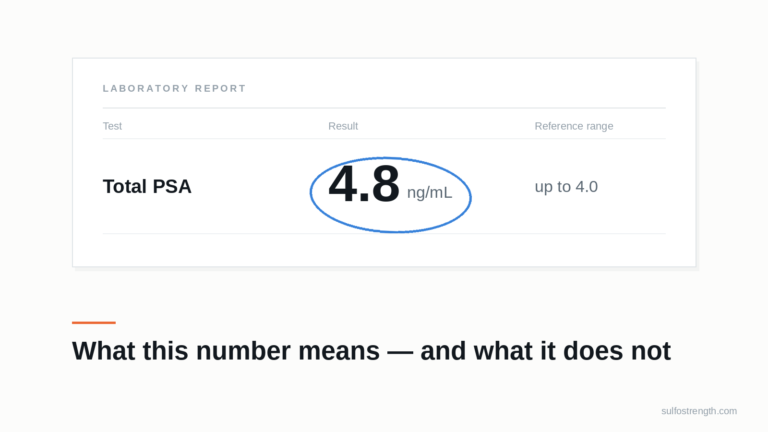
If you have arrived here after a blood test, you probably already know how much attention prostate cancer receives. Books, campaigns, a month with a colour of its own, risk calculators.
Now try to remember the last time you read anything about benign enlargement — the adenoma.
It affects incomparably more men. It is responsible for most cases of a raised PSA. It has changed the lives of millions — not dramatically, but slowly, a few minutes at a time, night after night. And it is discussed so rarely that most men first learn its name from a urologist.
This article is an attempt to put that right.
First: it is not cancer, and it does not become cancer
Benign prostatic hyperplasia — the adenoma — is enlargement of the prostate caused by more cells, not by altered cells. That is precisely what “hyperplasia” means: more of something normal.
This has to be said plainly, because the misunderstanding is widespread: an adenoma is not a pre-cancer, it does not turn into carcinoma, and having one does not raise your risk of prostate cancer. A man may have both at once — simply because both are common after a certain age — but one does not lead to the other.
The difference shows in where they begin. And this is the most useful thing in the whole article.
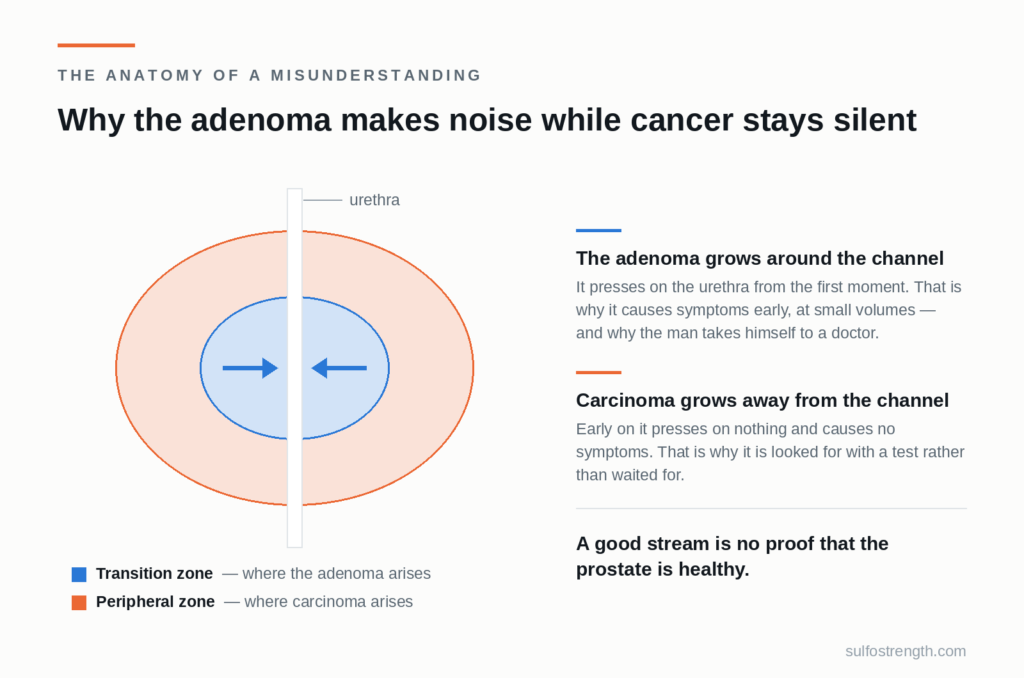
Why the adenoma makes noise while cancer stays silent
The prostate is not a uniform lump of tissue. It has zones, and they behave differently.
The transition zone is a small region immediately around the urethra — the channel urine passes through. The peripheral zone is the outer layer, towards the rectum, away from the channel.
An adenoma almost always arises in the transition zone. Carcinoma — in the great majority of cases — in the peripheral one.
Almost everything else follows from that geographical fact:
The adenoma presses on the channel from the first moment. That is why it produces symptoms early, at small volumes, and why the man takes himself to a doctor.
Carcinoma grows away from the channel. That is why, in its early stages, it produces no symptoms at all — and why it is looked for with a blood test rather than waited for.
From this comes a dangerous piece of everyday logic, worth demolishing on the spot:
“I pass water normally, so my prostate must be fine.”
It does not follow. A good stream says something about the transition zone. About the peripheral zone it says nothing.
And the opposite mistake, just as common:
“I’m up five times a night — it must be cancer.”
That does not follow either. Five trips a night speak very loudly for an adenoma and very faintly for carcinoma, precisely because the tumour is rarely where the channel is.
How common it is
The figures come from post-mortem studies — the only way to establish how many men actually have an adenoma, rather than how many have symptoms from one.
| Age | Proportion with histological adenoma |
|---|---|
| 41–50 | 23% |
| 51–60 | 42% |
| 61–70 | 71% |
| 71–80 | 82% |
After Berry and colleagues, 1984.
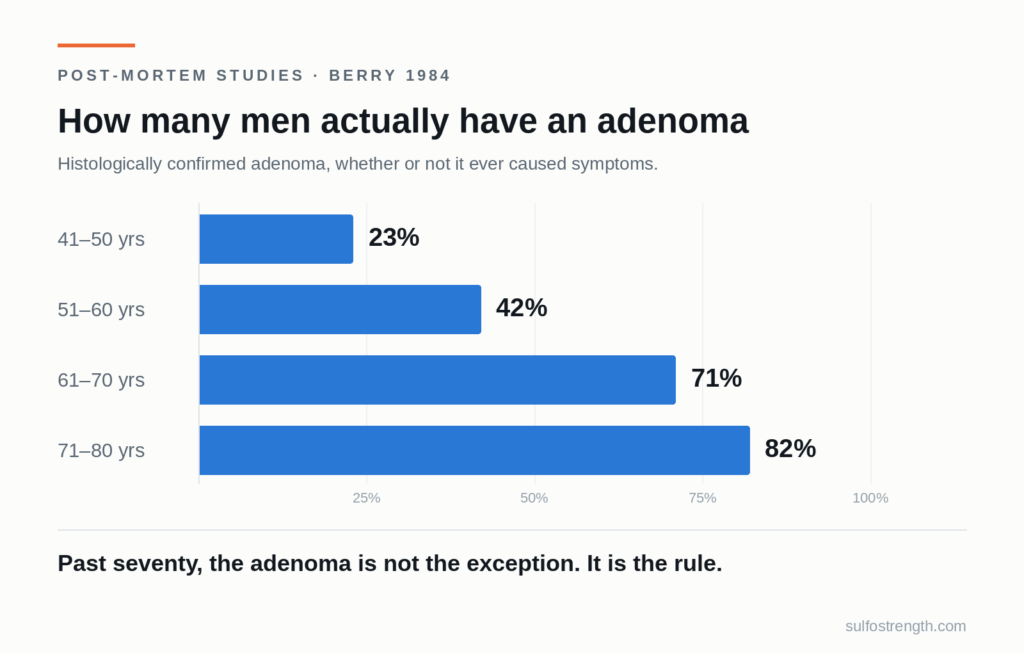
Look at those percentages again. At seventy, an adenoma is not a minority condition — it is the rule. Not having one is the unusual case.
But histology is not life. Moderate to severe symptoms affect roughly one man in eight in his forties and fifties and roughly one in three over sixty-five. So between “has an adenoma” and “suffers from an adenoma” lies a wide gap.
That gap is the next question.
Why size barely predicts symptoms
A man with a 100-millilitre prostate may pass water without any difficulty. Another, with 35 millilitres, may be up five times a night and unable to face a bus journey.
This looks senseless until you see the mechanism. The obstruction to flow has two parts, and they are entirely different in nature.
The static part is the tissue itself: the bulk that physically narrows the channel. It changes slowly — over years — and the only things that reduce it are shrinking the gland or removing tissue.
The dynamic part is the tone of the smooth muscle in the prostate and bladder neck. These muscles answer to alpha receptors and can tighten the channel within seconds. They explain why symptoms vary from day to day, why they worsen with stress, cold and fatigue, and why a man with a small prostate can be worse off than one with a large prostate.
Remember this division — it is the whole logic of treatment. The two main classes of drug used in adenoma attack precisely these two different things, which is why they work at different speeds and why they are sometimes given together.
There is a third participant that is rarely mentioned: the bladder itself. After years of working against resistance, its wall changes — it thickens, becomes less elastic and more irritable. Part of the symptoms no longer come from the prostate but from a tired bladder. That is why, after a successful operation, frequency sometimes does not disappear entirely: the obstruction has gone, but the bladder remembers.
Score yourself — it takes two minutes
There is an international questionnaire, the IPSS, used by urologists worldwide. It is not complicated, and there is no reason not to fill it in before your appointment — it will make the consultation incomparably more useful.
Seven questions. For each you answer with a number from 0 to 5:
0 — not at all · 1 — less than 1 time in 5 · 2 — less than half the time · 3 — about half the time · 4 — more than half the time · 5 — almost always
The questions, for the past month:
- Have you had a sensation of not emptying your bladder completely after passing water?
- Have you had to pass water again less than two hours after you finished?
- Have you found that you stopped and started again several times?
- Have you found it difficult to postpone passing water?
- Have you had a weak stream?
- Have you had to push or strain to begin?
- How many times do you get up at night? (here the number is simply the number of times — 0 to 5)
Add them up. The maximum is 35.
| Total | Severity |
|---|---|
| 0–7 | mild |
| 8–19 | moderate |
| 20–35 | severe |
And there is an eighth question, which does not count towards the total but is often the most important of all:
If you had to live with your urinary condition just as it is now, for the rest of your life, how would you feel about it?
From 0 (delighted) to 6 (terrible).
This question decides more than the total does. A man scoring 18 who is not bothered, and a man scoring 12 who has stopped going out in the evening, have different problems and deserve different answers. The number describes the symptom; the eighth question describes the life.
What the doctor does — and what is not needed straight away
Sensible initial assessment is short:
Conversation and the questionnaire. When it started, what has changed, what medicines you take.
Digital rectal examination. Unpleasant for ten seconds, informative. It judges size and — more importantly — whether the surface is smooth. An adenoma is smooth and elastic; a hard nodule is a different conversation.
Urine test. To exclude infection and blood, which cause the same symptoms.
PSA. A substantial qualification is needed here.
Residual urine. An ultrasound immediately after passing water — how much is left in the bladder. Painless and very telling.
Uroflowmetry. You pass water into a device that measures the speed of the stream. It turns the feeling of “weak flow” into a number.
Prostate volume. By ultrasound. It matters less for the diagnosis than for the choice of treatment — see below.
What is not needed at the outset: biopsy (in a purely adenomatous picture there is no basis for it), MRI (where carcinoma is suspected, yes — but that is a different question), urodynamics (kept for unclear cases).
About PSA in benign enlargement
An adenoma raises PSA. More tissue means more of the protein produced. This is the commonest cause of an above-threshold value of all — commoner than cancer.
So a raised PSA in a man with an enlarged prostate is neither a surprise nor a verdict. It is a number that calls for context: the volume of the prostate, the free PSA, the direction of travel over time. (Read more: “PSA 4.8. What this number means — and what it does not“.)
And one trap that bears repeating: if you take finasteride or dutasteride, your PSA is roughly half the true figure. After about six months on the drug the value halves. Your doctor needs to know you are taking it — including if it was prescribed for hair loss.
The treatment ladder
The most useful way to think about an adenoma is as a ladder. You climb only as far as you must, and you come down when you can.
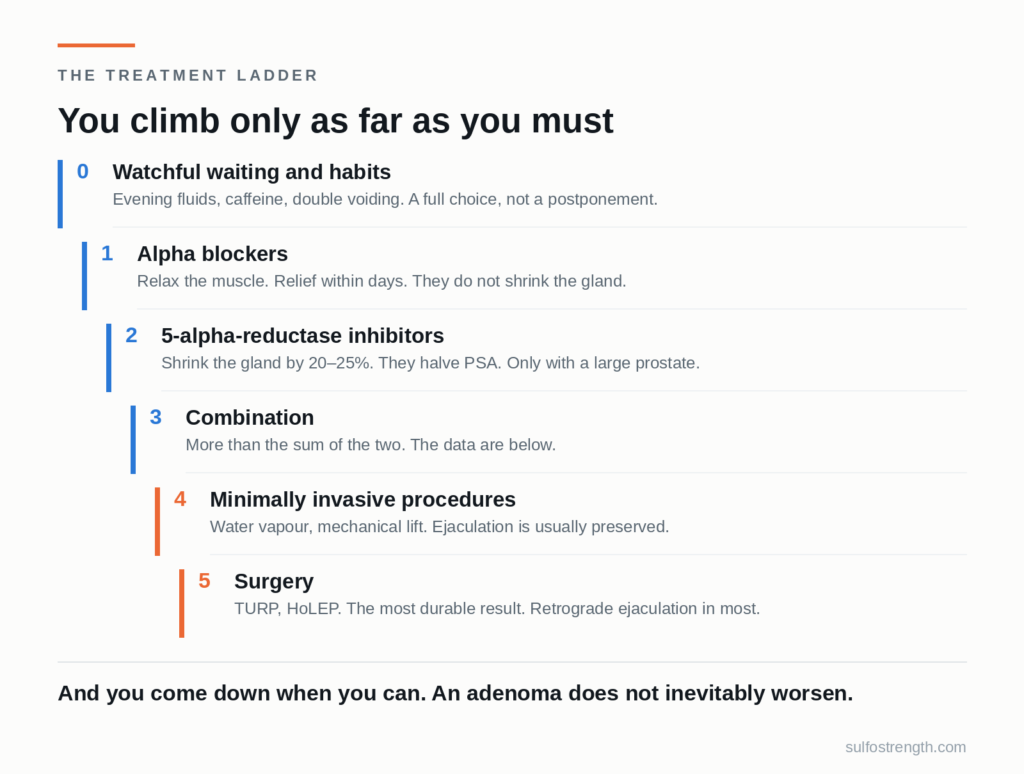
Step 0 — watchful waiting and changing habits
Undeservedly underrated. With mild symptoms and an untroubled man, this is a full choice, not a postponement.
An adenoma is not a condition that inevitably worsens. In a substantial proportion of men symptoms stay stable for years, and in some they improve on their own.
What actually helps:
- Redistributing fluids. Not less in total, but less in the evening. Stop two or three hours before bed.
- Caffeine and alcohol. Both are diuretics and both irritate the bladder. Cutting them is the fastest change with a visible effect.
- Double voiding. When you have finished, wait half a minute and try again. There is often more.
- Timed voiding rather than going at the first signal — it teaches the bladder to wait.
- Constipation. A full rectum presses from behind. It sounds trivial. It is not.
- Movement. A sedentary life makes things worse; regular physical activity is associated with fewer symptoms.
Step 1 — alpha blockers
Tamsulosin, silodosin, alfuzosin, doxazosin, terazosin.
What they do: relax the smooth muscle — the dynamic part of the obstruction.
How fast: days to two weeks. This is the quickest relief that exists in benign enlargement.
What they do not do: they do not shrink the prostate, do not change the course of the condition, and do not reduce the long-term risk of retention or surgery.
The price: dizziness and a drop in blood pressure on standing, especially at the start and especially with the older members of the class. And retrograde ejaculation — semen travels back towards the bladder instead of out. It is harmless, but for some men it is unacceptable, and they are almost never told in advance. Silodosin causes it most often, alfuzosin least.
One more thing: if cataract surgery is coming up, tell the ophthalmologist you are on an alpha blocker. There is a floppy iris syndrome that complicates the operation, and the surgeon wants to know beforehand.
Step 2 — 5-alpha-reductase inhibitors
Finasteride, dutasteride.
What they do: reduce the conversion of testosterone into dihydrotestosterone — the hormone that sustains growth of the gland. The prostate genuinely shrinks, by around 20–25% over six to twelve months.
How fast: slowly. Before the sixth month, expect nothing.
Who they work for: only with a genuinely enlarged prostate — above roughly 30–40 millilitres. With a small gland the benefit is small while the side effects remain. That is why volume is measured before prescribing.
What else they do, and it matters: they are the only drugs shown to reduce the risk of acute urinary retention and of surgery.
The price: reduced libido, erectile difficulty and reduced ejaculate volume in a small minority of those who take them. There is also debate about whether, in some men, the complaints persist after stopping — the question is not settled, and honesty requires it to be mentioned rather than passed over. And, again: they halve PSA.
Step 3 — combination
Here there is real evidence, not opinion.
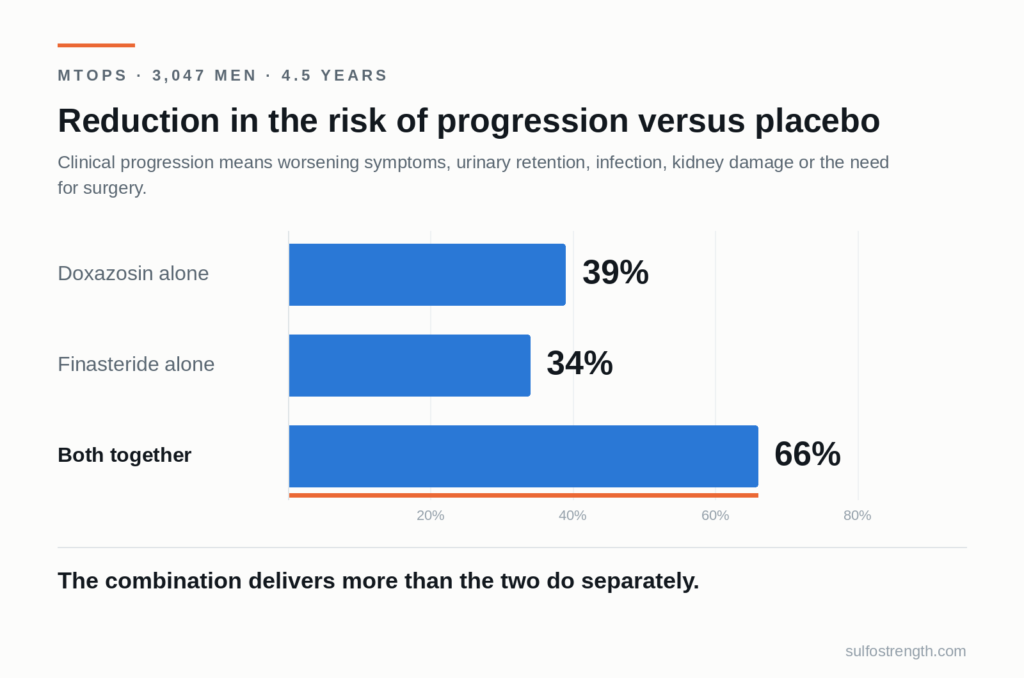
The MTOPS trial followed 3,047 men for an average of 4.5 years, in four groups: placebo, doxazosin, finasteride, and both together.
| Reduction in risk of progression | |
|---|---|
| Doxazosin alone | 39% |
| Finasteride alone | 34% |
| Both together | 66% |
The combination does not merely add the two effects — it delivers more than their sum.
And for the worst outcomes the difference is sharper still:
| Acute urinary retention | Invasive therapy | |
|---|---|---|
| Doxazosin alone | no significant effect | no significant effect |
| Finasteride alone | −68% | −64% |
| Combination | −81% | −67% |
Read that first row again. An alpha blocker relieves symptoms but does not change the course of the condition. A man can feel better for years and still be heading for the same operation. This is not an argument against alpha blockers — they do exactly what they are for — but against the belief that feeling better means the problem is solved.
The later CombAT trial — 4,844 men, four years, dutasteride versus tamsulosin versus the combination — confirmed the same direction.
The price of combination is the sum of the side effects of both. So it is not a starting point but a decision for a man with a large prostate and a real risk of deterioration.
Step 4 — minimally invasive procedures
The last fifteen years have changed this section more than anything else, and much of the change has not yet reached the general picture people carry in their heads.
Water vapour (Rezūm). Several injections of water vapour, around nine seconds each, are delivered into the prostate tissue through the urethra. The vapour releases its heat, the tissue dies and is absorbed by the body over weeks. An outpatient procedure.
Five-year follow-up data: IPSS improved by about 48% from baseline, 4.4% of men needed a repeat intervention within five years and — the essential point — ejaculation is preserved. Reported retrograde ejaculation is around 3%, essentially baseline.
Mechanical lift (UroLift). Small implants are placed that physically pull the two lobes aside and open the channel, with no cutting or heating of tissue. The effect is immediate, and ejaculation is likewise preserved. It suits a particular gland shape — not every one.
These are procedures for a man with moderate symptoms who wants more than tablets but is not ready for surgery and cares about sexual function.
Step 5 — surgery
TURP — transurethral resection — is the method everything else has been measured against for decades. Tissue is cut away from the inside, through the channel. The result is the largest and most durable improvement in flow.
The price is known and must be stated in advance: retrograde ejaculation in the majority of those operated on. In the United Kingdom’s National Prostatectomy Audit of 1997 the rate was 68%. Technique has improved since, but this particular effect remains the rule rather than the exception. Erectile dysfunction is considerably rarer — 6.5% in the same audit.
HoLEP and similar laser enucleation techniques remove all of the adenomatous tissue rather than part of it. They suit very large glands, where TURP becomes risky, and they carry a lower reoperation rate. They require a trained operator and so are not offered everywhere.
Open adenomectomy remains for very large prostates where laser equipment is unavailable.
The comparison in brief
| Speed | Shrinks the gland | Ejaculation | Durability | |
|---|---|---|---|---|
| Habits | weeks | no | unaffected | variable |
| Alpha blocker | days | no | often retrograde | while taken |
| 5-ARI | months | yes, 20–25% | possible effects | while taken |
| Combination | days + months | yes | sum of both | while taken |
| Water vapour | weeks | partly | usually preserved | ~95% retreatment-free at 5 yrs |
| UroLift | days | no | usually preserved | lower than surgery |
| TURP / HoLEP | immediate | yes, durably | retrograde in most | highest |
The trap almost nobody warns about
A man with an adenoma walks into a pharmacy with a blocked nose. He buys the usual cold remedy. During the night he cannot pass water at all and ends up in the emergency department with a catheter.
This happens regularly and is almost entirely preventable.
Decongestants — pseudoephedrine, phenylephrine — tighten smooth muscle everywhere, including at the bladder neck. They are the precise opposite of an alpha blocker.
Older-generation antihistamines and many “cold and flu” remedies have anticholinergic activity, which relaxes the muscle of the bladder itself. The bladder cannot contract hard enough.
Combination cold preparations often contain both.
The list goes on with some stomach, allergy and sleep medicines and some antidepressants. The rule is simple: with an adenoma, every new medicine — including over the counter — is mentioned to the doctor or pharmacist.
When not to wait
Most of this article is about how rarely haste helps. There are, however, situations where the opposite is true.
- Complete inability to pass water with a full bladder. Acute retention. An emergency.
- Blood in the urine. It may be from the adenoma; it may not. It gets investigated.
- Repeated urinary tract infections.
- Bladder stones.
- Deteriorating kidney function, found on blood tests.
- A large residual volume that grows on follow-up.
These are not arguments for panic. They are the boundary beyond which watchful waiting stops being a reasonable choice and becomes postponement.
What we still do not know
Honesty requires this section too.
We do not know why an adenoma grows quickly in one man and not at all in another. There is no reliable way to predict whose case will worsen.
We do not know why size corresponds so weakly to symptoms — we have mechanisms that explain part of the mismatch, but not all of it.
We do not know how far diet and way of life affect the development of the adenoma itself, as distinct from their effect on symptoms, which is better documented.
And the question of prolonged sexual complaints in a small minority of men who have taken 5-alpha-reductase inhibitors is not fully resolved.
Anyone who presents these questions to you as settled is more confident than the science.
Five questions worth asking at the appointment
- What is the volume of my prostate? It decides whether certain drugs make sense at all.
- How much residual urine do I have? That is the number we will be following.
- Does this medicine relieve the symptom or change the course? They are different things.
- How will it affect ejaculation? The question is appropriate, and the doctor is obliged to answer.
- If we wait six months, what am I risking? For many men the answer is “nothing” — and that deserves to be heard.
Finally
An adenoma is a condition in which most men have a choice rather than a prescription. It can be watched. It can be treated with a tablet. It can be settled with a day procedure. It can be operated on.
What is almost never sensible is to live with it without understanding it — to be up five times a night for years because “at my age that’s normal”.
Normal in the sense of common. Not normal in the sense that nothing can be done.
Sources
- Berry S. et al. The development of human benign prostatic hyperplasia with age. Journal of Urology, 1984.
- McConnell J. et al. The Long-Term Effect of Doxazosin, Finasteride, and Combination Therapy on the Clinical Progression of Benign Prostatic Hyperplasia (MTOPS). New England Journal of Medicine, 2003.
- Roehrborn C. et al. The effects of dutasteride, tamsulosin and combination therapy on lower urinary tract symptoms (CombAT). Journal of Urology, 2008.
- McVary K. et al. Five-year results of water vapour thermal therapy for benign prostatic hyperplasia (Rezūm II). Journal of Urology / subsequent analyses.
- National Prostatectomy Audit, United Kingdom, 1997 — complication rates after TURP.
- Barry M. et al. The American Urological Association symptom index for benign prostatic hyperplasia (the basis of the IPSS). Journal of Urology, 1992.
- European Association of Urology (EAU) — Guidelines on the management of non-neurogenic male lower urinary tract symptoms, current edition.
Articles in this section are published by SulfoStrength — official distributor of a food supplement for Bulgaria, Romania and Greece. They are the result of focused work in this field and of looking for answers that people sometimes cannot find.
This text is informative and does not replace a consultation with a doctor. Decisions about investigation and treatment are made by the treating physician, in the light of the individual case.
More about us and the products we represent: SulfoStrength