
The lab has given you one line: Total PSA — 4.8 ng/mL. Underneath it, in small print, “reference range: up to 4.0”. The number is above the limit. Nothing else has been explained to you.
If you went online from there, you have already read the word everyone is afraid to say out loud.
(The figure 4.8 is illustrative — chosen precisely because it is one of those numbers that say nothing on their own and therefore frighten the most. It could be 4.2. It could be 6.1. The logic below is the same.)
This article is about what a raised PSA actually means — and why, in most cases, it does not mean the thing that frightened you.
PSA is not a cancer test
This is the first thing that needs saying plainly.
Prostate-specific antigen is a protein produced by prostate cells — by the healthy ones too, not only the diseased. Its job is to liquefy seminal fluid. Small amounts reach the bloodstream, and that is exactly what the test measures.
A raised PSA means one thing: the prostate is producing more than usual, or letting more through into the blood. The reasons for that are many, and cancer is only one of them — and not the most common.
The test does not distinguish between causes. It only counts.
The 4.0 threshold is a convention, not a law of nature
The number 4.0 looks like a boundary between health and disease. It is not. It was chosen in clinical studies in the 1980s as a practical compromise — low enough to catch disease, high enough not to send everyone to biopsy.
In 2004, an American study showed something that changed the understanding: among nearly 3,000 men with a PSA below 4.0 who were biopsied with no other indication, cancer was found in 15.2% of cases. Roughly one in seven of those were aggressive forms.
The reverse is equally true. Most men with a PSA between 4 and 10 do not have cancer.
The conclusion is not that the test is useless. The conclusion is that there is no safe value, and no value that by itself makes a diagnosis. The number is the entrance to a conversation, not the answer.
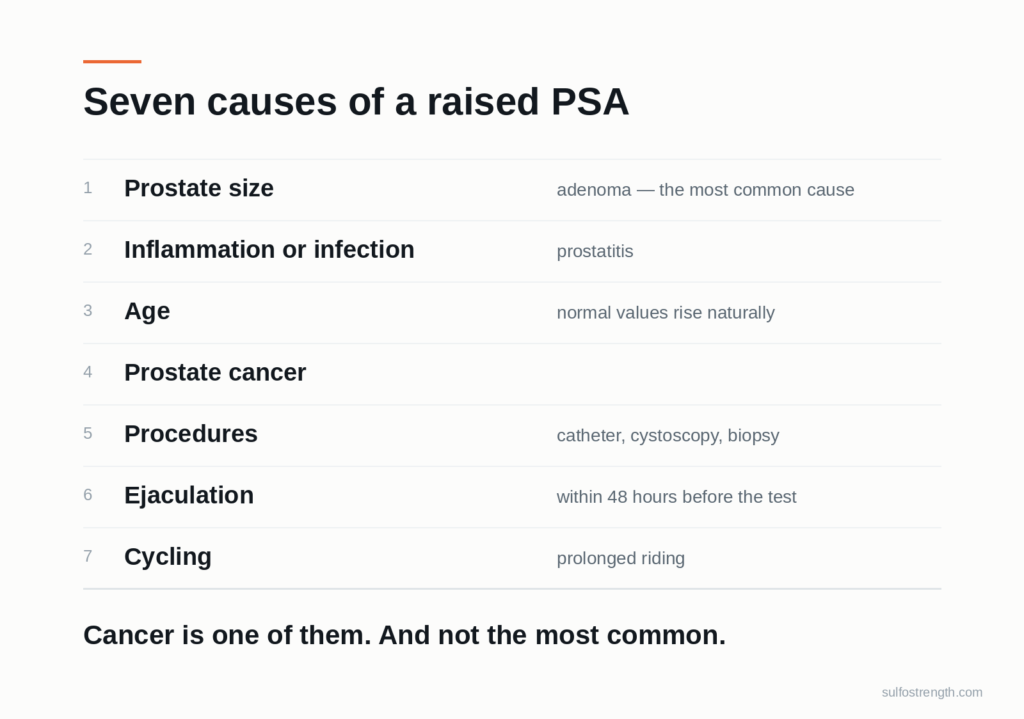
What else raises PSA
| Cause | What it does |
|---|---|
| Age | Normal values rise naturally. What is high at 50 may be ordinary at 70. |
| Prostate size | Benign enlargement (adenoma) is the single most common cause of a raised PSA. More tissue — more protein. |
| Inflammation or infection | Prostatitis can raise the value several times over. Sometimes to numbers that look dramatic. |
| Ejaculation | Within 48 hours before the test it can add around 0.4. |
| Cycling | Prolonged riding before the test — a possible, though small, effect. |
| Procedures | Catheterisation and cystoscopy raise PSA, and biopsy raises it considerably. After a biopsy, several weeks of waiting are needed. |
The trap that is missed most often
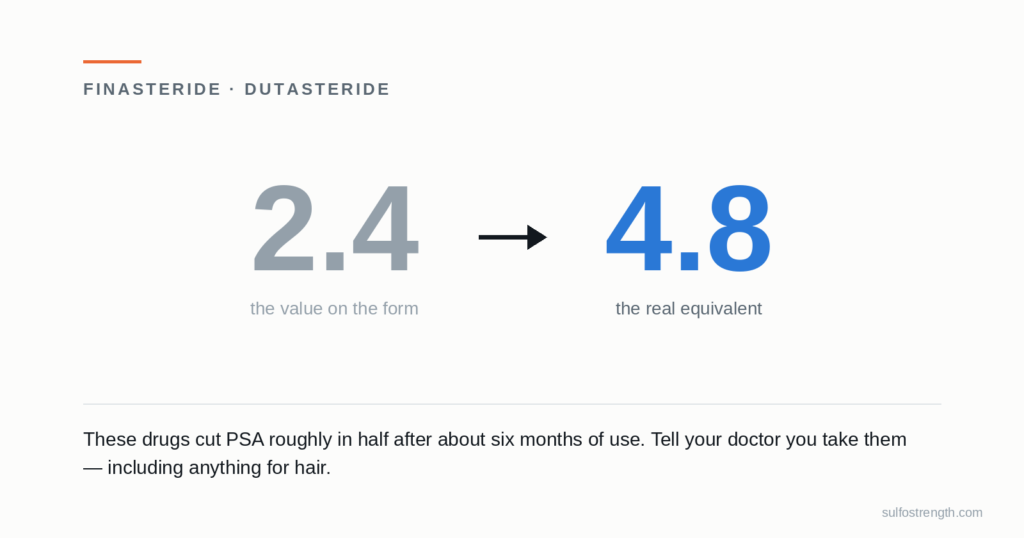
If you take finasteride or dutasteride — drugs for prostate enlargement or for hair loss — they cut PSA roughly in half after about six months of use.
That means your 2.4 actually corresponds to 4.8. A man who takes such a drug and has not mentioned it can be reassured by a value that is in fact concerning.
Tell your doctor what you take. Including anything for hair.
A single measurement means nothing
This is the most important practical sentence in this article.
PSA fluctuates. In the same man, with nothing having changed, two measurements a month apart can differ by twenty to thirty per cent. Different laboratories use different methods.
That is why a raised value is not interpreted on its own. It is repeated after four to six weeks, under conditions that do not distort it:
- no ejaculation for 48 hours beforehand
- not during a urinary tract infection
- not straight after cycling or prolonged sitting
- in the same laboratory, where possible
Surprisingly often, the second measurement comes back normal. That is not an error in the first one — that is how this marker behaves.
What comes next, if the value is confirmed
Today’s pathway does not run straight to biopsy. This is a change of the last few years, and it has not yet reached every doctor’s consulting room.
Free PSA. In the blood, the protein circulates both bound and free. At values between 4 and 10, the ratio helps: a low percentage of free PSA points to higher risk, a high percentage to lower.
PSA density. The value divided by the volume of the prostate. A large prostate producing 5 is a different matter from a small prostate producing the same.
MRI before biopsy
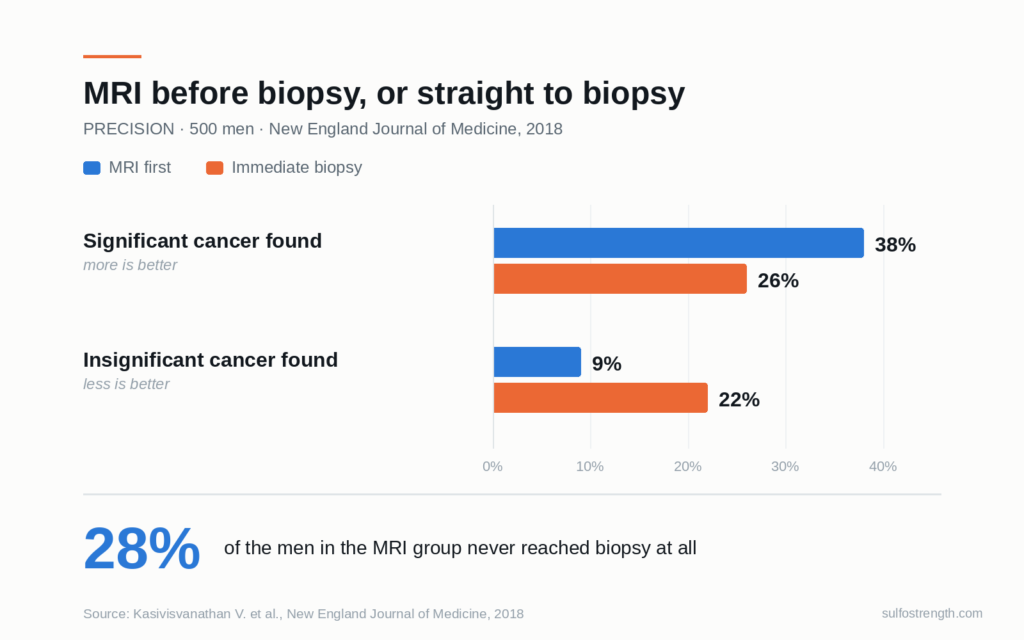
In 2018, the PRECISION trial was published in the New England Journal of Medicine — international, randomised, with 500 men suspected of prostate cancer who had not previously been biopsied.
The men were split into two groups. One followed the old route: immediate biopsy, twelve cores taken “blind” from different zones. The other was imaged first with MRI, and biopsy was performed only where a suspicious lesion was seen — and then targeted, into the lesion itself.
The results:
| MRI first | Immediate biopsy | |
|---|---|---|
| Significant cancer found | 38% | 26% |
| Insignificant cancer found | 9% | 22% |
| Avoided biopsy altogether | 28% | — |
In other words, the MRI-first approach found more of what matters and less of what only creates anxiety and leads to unnecessary treatment. And more than a quarter of the men never reached biopsy at all — the imaging was clear.
MRI findings are graded from 1 to 5 on the PI-RADS scale. At 1 and 2, biopsy is usually not required.
If a biopsy is proposed without an MRI having been done, the question “why not imaging first?” is a reasonable one, and not an expression of mistrust.
The uncomfortable thought
There is something that is rarely said out loud: finding cancer is not automatically either good or bad.
Prostate carcinoma often grows so slowly that a man dies with it rather than from it. Some of the cases found by screening would never have caused a symptom. But once found, they are hard to leave alone — and the man takes on the risks of treatment for a disease that would not have affected him.
The other side is just as true: there are aggressive forms in which early detection changes everything.
So the test is worth doing — but its result is not a verdict in either direction. It is information to work with.
That is precisely why active surveillance exists as an equally valid option in a proportion of cases — a protocol with strict criteria, regular testing and planned biopsies, in which treatment is deferred but nothing is neglected. (Read more: “Active surveillance in prostate cancer — why sometimes the best decision is not to treat immediately”.)
And if the prostate has already been removed — none of the above applies
This section is for a different group of people, and it matters that they read it.
After radical prostatectomy, the prostate is gone. There is no tissue to produce PSA. So the expected value is not “under 4” — it is effectively zero.
Most laboratories report anything below 0.1 ng/mL as undetectable.
Here the numbers are read on an entirely different scale. A value of 0.2, confirmed by a second measurement, is taken as biochemical recurrence — meaning prostate tissue has either remained somewhere or appeared. That is a number which, in a man with an intact prostate, would be entirely normal, and which after surgery means something quite different.
We have seen this misunderstanding: a man after prostatectomy gets 0.3, sees the reference range “up to 4.0”, and is reassured. The limit printed on the form is for people who have a prostate. For him it has no meaning.
If you have had surgery: any distinct number deserves a conversation with your urologist, however small it looks. And here, more important than the value itself is how fast it is rising — a measure called doubling time, calculated from at least three measurements. (Read more: “What PSA doubling time means after radical prostatectomy, and why your doctor watches it“.)
As for what follows surgery in general — when the catheter comes out, what the histology report says, when recovery is expected — those are questions for your surgical team, and better asked before the operation than after.
What to do, if you are holding a sheet of paper with a number above the limit
- Do not take a single measurement as fact. Repeat it in a month, under the right conditions.
- Name every medication you take — especially anything for the prostate and anything for hair.
- Ask about free PSA and about the volume of your prostate.
- If biopsy is being discussed, ask whether an MRI is appropriate first.
- Ask for your previous values. The direction is more informative than the point.
The number by itself is not a diagnosis. It is a reason to ask the right questions.
And something that deserves a text of its own
Did you notice which cause sits at the top of the table by frequency?
Benign enlargement of the prostate — adenoma. It is by far the more common culprit behind a raised PSA than cancer is, it affects the majority of men past a certain age, and it is nonetheless discussed incomparably less.
Most men worrying today about a number above 4 in fact have this.
On adenoma — what it is, how it differs from cancer, what the symptoms are and when it genuinely requires intervention — we will write separately. It deserves more than one row in a table.
Sources
- Thompson I. et al. Prevalence of Prostate Cancer among Men with a PSA Level ≤ 4.0 ng per Milliliter. New England Journal of Medicine, 2004.
- Kasivisvanathan V. et al. MRI-Targeted or Standard Biopsy for Prostate-Cancer Diagnosis (PRECISION). New England Journal of Medicine, 2018.
- Catalona W. et al. Use of the percentage of free prostate-specific antigen to enhance differentiation of prostate cancer. JAMA, 1998.
- European Association of Urology (EAU) — Guidelines on Prostate Cancer, current edition.
- American Urological Association (AUA) — Early Detection of Prostate Cancer Guideline.
The articles in this section are published by SulfoStrength — official distributor of a food supplement for Bulgaria, Romania and Greece. They are the result of focused work in this field and of looking for answers that people do not always find.
This text is for information only and does not replace a medical consultation. Decisions about tests and treatment are made by the treating physician, in light of the individual case.

