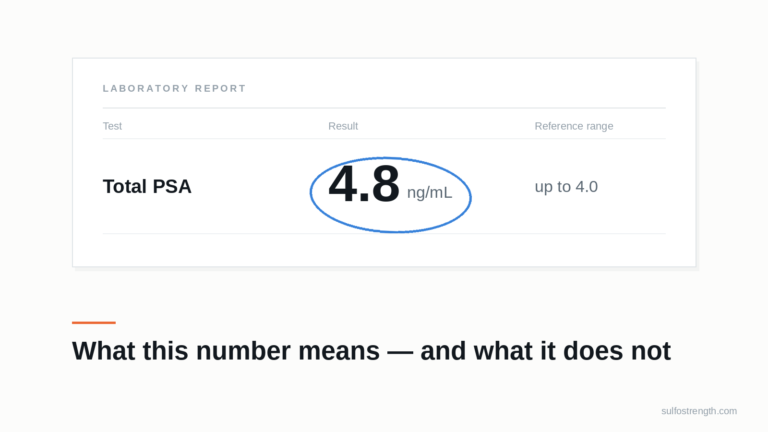
Few sentences sound as contradictory as “you have cancer, but for now we’re not going to do anything.”
For the person hearing it, this is often more frightening than a proposal for surgery. If it’s cancer — why are we waiting? If it can wait — is it really cancer?
The answer is that in a certain group of men, immediate treatment doesn’t extend life, but it certainly reduces its quality. This article explains when this is the case, what criteria the decision is based on, and what surveillance actually means in practice.
| This article is for educational purposes. It is not medical advice and does not replace a consultation with a urologist. The assessment of a specific case is made by the treating physician, who has full access to the relevant information. |
What Active Surveillance Is — and What It Isn’t
Active surveillance is a strategy in which a diagnosed cancer is not treated immediately but is instead monitored according to a defined protocol. The goal is to delay treatment until it becomes necessary — and for some men, it never becomes necessary.
It’s important to distinguish this from watchful waiting. That approach is used in men with limited life expectancy and is not aimed at cure; it responds only when symptoms appear. Active surveillance, by contrast, preserves the full option of curative treatment and calls for switching to it at the first signs of change.
The difference matters. Active surveillance is not a refusal of treatment. It is deferred treatment with regular monitoring.
Why This Approach Exists at All
Prostate cancer has a feature that sets it apart from most other cancers: a large share of cases progress extremely slowly. In these cases, the likelihood that the man will die of something else far exceeds the likelihood that the tumor will threaten him.
At the same time, treatment is not harmless. Radical prostatectomy and radiotherapy carry risks of urinary incontinence, erectile dysfunction, and bowel problems that can persist for years.
That’s why, for a slowly progressing disease, the decision isn’t “treatment or nothing,” but “treatment now or treatment later, when there’s a reason for it.”
Who Meets the Criteria
The European Association of Urology guidelines define active surveillance as an appropriate approach for men with low-risk prostate cancer. The classification is based on three criteria, which must all be present at the same time:
| Indicator | Value for Low Risk |
|---|---|
| Stage | T1 to T2a — the tumor is confined to the prostate and is either not palpable or involves no more than half of one lobe |
| PSA | below 10 ng/mL |
| ISUP Grade | ISUP 1, corresponding to Gleason 3+3 = 6 |
The 2024 guidelines expand the scope: active surveillance is also discussed for selected patients with favorable intermediate risk and ISUP grade 2.
Some protocols add further conditions — for example, a number of positive biopsy cores below a certain threshold, or a PSA density below 0.15 ng/mL per cubic centimeter.
Outside these boundaries, active surveillance is generally not appropriate, and treatment is discussed instead.
What the Protocol Involves
The word “active” is key. This isn’t about waiting — it’s about a schedule.
- PSA testing — at least once every six months.
- Digital rectal exam — at least once a year.
- Magnetic resonance imaging (MRI) — recommended before starting surveillance, if not already done.
- Follow-up biopsies — on a schedule set by the treating team.
The guidelines clarify two points about imaging. If MRI shows progression, this requires a repeat biopsy to confirm it histologically before the strategy is changed. Conversely, a stable MRI does not automatically eliminate the need for a repeat biopsy — but in a low-risk tumor with a consistently low PSA density below 0.15, it may be omitted.
In other words, surveillance requires discipline. It’s a lighter regimen than treatment, but it isn’t the absence of one.
What the Long-Term Data Show
The strongest evidence comes from the British ProtecT trial — 1,643 men with localized prostate cancer, randomly assigned to one of three groups: active surveillance (monitoring), radical prostatectomy, or radiotherapy. The 15-year results were published in the New England Journal of Medicine in 2023.
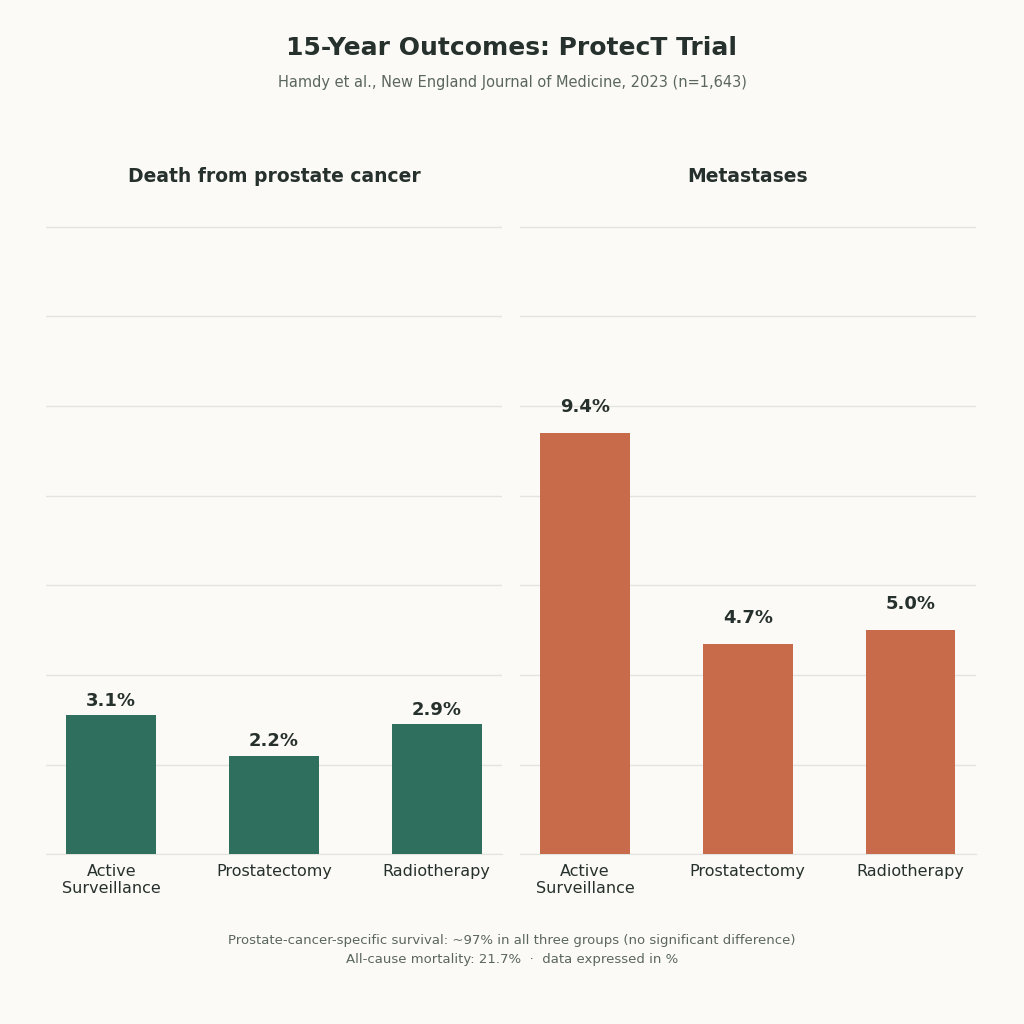
Prostate-cancer-specific survival was about 97% in all three groups, with no statistically significant difference. Of the 2.7% overall who died of prostate cancer, the breakdown was 3.1% in the surveillance group, 2.2% after surgery, and 2.9% after radiotherapy.
All-cause mortality was 21.7%, with more than half of deaths due to cardiovascular and respiratory disease. In other words, the men in the study died mostly of something else.
And one detail that’s rarely cited: at year fifteen, a quarter of the men in the surveillance group were alive without ever having received treatment.
The Other Side of the Data
The same study also shows the cost of waiting. Metastases were reported in 9.4% of the surveillance group, compared with 4.7% after prostatectomy and 5% after radiotherapy.
So the disease does progress more often under surveillance. But that difference does not translate into a survival difference — which is the study’s central finding.
The researchers note something else that reshapes the picture: men with metastases don’t always die of prostate cancer.
There’s also something the numbers don’t show. Real-world data indicate that a significant share of men discontinue surveillance — and the most common reason isn’t progression, but personal choice. Living with the knowledge that there’s untreated cancer in your body isn’t easy for everyone. That’s a real factor in the decision, not a weakness.
When Surveillance Turns Into Treatment
Several things can prompt a reassessment: an increase in grade on a follow-up biopsy, PSA progression, a change in MRI findings, or the patient’s own wish.
In the ProtecT trial, the trigger for reassessment was a PSA rise of at least 50% within twelve months, as well as any concern raised by either the patient or the physician.
The key point is that moving to treatment is not a failure of surveillance. It is the anticipated outcome in some cases — and that’s exactly why surveillance is called “active.”
What’s Reasonable to Do
- Ask explicitly whether you meet the criteria. Three indicators determine this: stage, PSA, and ISUP grade. If all three of your values fall within the low-risk range, active surveillance is an option the guidelines recommend discussing.
- Ask to see the protocol. When PSA is checked, when MRI is done, when biopsies are taken, and at what values action is triggered. Surveillance without a clear schedule is not active surveillance.
- Keep track of your values. The same holds as with follow-up after surgery — the trend tells you more than any single number.
- Discuss the side effects of the alternative, too. The decision isn’t based on survival alone, but on the balance between benefit and harm. That is precisely the conclusion drawn by the ProtecT researchers.
And one thing that isn’t medical: if the anxiety of waiting becomes overwhelming, tell your doctor. That’s a legitimate part of the conversation, not a weakness to hide.
Sources
- Hamdy FC, et al. Fifteen-Year Outcomes after Monitoring, Surgery, or Radiotherapy for Prostate Cancer. New England Journal of Medicine, 2023.
- EAU-EANM-ESTRO-ESUR-ISUP-SIOG Guidelines on Prostate Cancer, 2024 Update, Part I. European Urology.
- Summary of the European Association of Urology guidelines on prostate cancer, 2025.
- Published cohort data on retention in active-surveillance protocols in real-world practice.
About the Publisher
This article was prepared by the SulfoStrength team — the official distributor of Prostaphane for Bulgaria, Romania, and Greece. The material is educational and does not contain a product recommendation.
If anything in this article is inaccurate or unclear, write to us — we’ll fix it.
Tags: #ProtecT #PSA #ActiveSurveillance #MensHealth #ProstateCancer