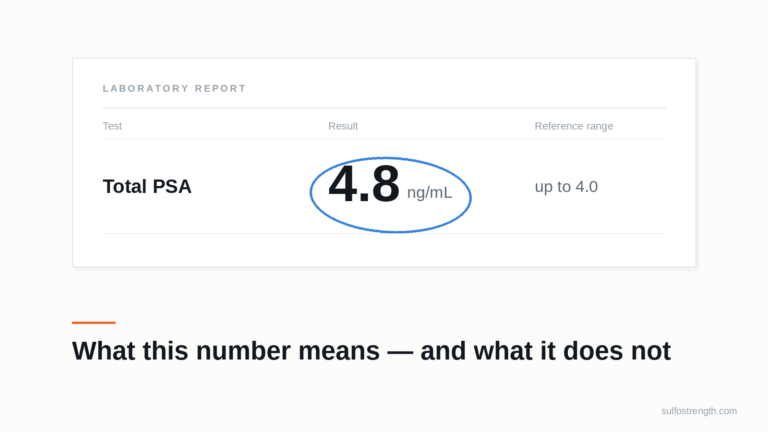
Why PSA Is Measured After Surgery
PSA (prostate-specific antigen) is a protein produced almost exclusively by prostate cells. Once the prostate has been surgically removed, its source essentially disappears, and PSA levels should fall to an undetectable level.
This is precisely what makes PSA such a valuable marker after surgery. Since the prostate is no longer present, any measurable amount of PSA indicates that prostate cells remain somewhere in the body. For this reason, PSA monitoring continues for years after prostatectomy, even when everything appears to be normal.
What “Biochemical Recurrence” Means
When PSA begins to rise after radical prostatectomy, the condition is known as biochemical recurrence (BCR). The European Association of Urology defines biochemical recurrence as a PSA level of 0.2 ng/mL or higher, confirmed by a second test. Some American guidelines use a lower threshold and define recurrence based on a rising PSA in two or more consecutive measurements.
The word recurrence often sounds alarming. In reality, it describes a laboratory finding, not a clinical diagnosis. Biochemical recurrence simply means that PSA has become detectable. It does not necessarily mean there is a visible tumor, metastatic disease, or any symptoms. For many men, years may pass between biochemical recurrence and anything becoming detectable on imaging studies.
Published data suggest that up to 30% of men who undergo radical prostatectomy experience biochemical recurrence within 15 years after surgery. It is a common scenario rather than an exception.
The Number Versus the Rate
This is the central message of this article.
Two identical PSA values can represent very different situations. A man whose PSA reaches 0.3 ng/mL over five years and another who reaches 0.3 ng/mL in just four months have the same laboratory result—but very different clinical outlooks.
For this reason, urologists pay less attention to the absolute PSA value than to the slope of the PSA curve. This slope is measured by PSA doubling time (PSADT).
PSA doubling time answers one simple question:
If PSA continues to rise at the current rate, how many months will it take to double?
A doubling time of six months indicates rapid growth. A doubling time of thirty months indicates slow growth.

What the Difference Looks Like
The illustration below shows two patients who both start at the same point: PSA 0.2 ng/mL.
After three years, one has reached 12.8 ng/mL, while the other has reached only 1.6 ng/mL—an eightfold difference caused solely by the rate of increase.
At the beginning, the two curves appear almost identical. That is why a single PSA measurement tells relatively little, while a series of measurements tells a great deal.
How PSA Doubling Time Is Calculated
The calculation uses the natural logarithm and is based on at least two PSA measurements taken at different times.
The formula is:
PSA Doubling Time = Time Interval × ln(2) / ln(Second PSA ÷ First PSA)
In practice, no one calculates this manually. Free online calculators are widely available—the best known is provided by Memorial Sloan Kettering Cancer Center—and most hospital information systems calculate it automatically.
More important than the formula itself is what it requires:
- Several PSA measurements
- Performed by the same laboratory
- At reasonably consistent time intervals
Two PSA values obtained from different laboratories or using different assay methods can produce misleading results. This is why urologists often recommend having follow-up PSA tests performed at the same laboratory whenever possible.
What the Thresholds Mean
PSA doubling time is not a diagnosis. It is one of several factors used to determine whether treatment should be started and, if so, when.
| PSA Doubling Time | Interpretation in Current Guidelines |
|---|---|
| More than 12 months | Together with a favorable ISUP grade (below Grade 4), this falls into the European Association of Urology’s low-risk category. Active surveillance, including continued PSA monitoring, may be appropriate. |
| 12 months or less | Classified as high risk, either alone or in combination with ISUP Grade 4–5 disease. Active treatment is generally considered. |
| Less than 6 months | Studies of salvage radiotherapy identify this threshold as a strong predictor of future disease progression. |
| More than 15 months | Published data suggest these patients are considerably more likely to die from causes other than prostate cancer. |
The last point deserves special attention.
When PSA doubling time is long, biochemical recurrence often becomes a chronic condition that a man lives with for many years, ultimately dying of something unrelated to prostate cancer.
Clinical Decisions That Depend on PSA Doubling Time
Whether treatment is needed now.
For low-risk patients, current guidelines support observation rather than immediate treatment, since treatment itself carries potential side effects. For example, salvage radiotherapy is associated with urinary complications in roughly one in five patients.
When to perform imaging.
PSMA PET/CT has limited sensitivity at very low PSA levels—generally below 0.5 to 1.0 ng/mL. PSA doubling time helps determine whether imaging should be performed immediately or whether waiting is more appropriate.
What type of treatment to consider.
Rapid PSA doubling raises concern for disease beyond the prostate bed, potentially requiring a different strategy than localized radiation alone.
How often PSA should be measured.
A slowly rising PSA may justify longer intervals between tests, while a rapidly rising PSA requires closer monitoring.
Four Important Limitations
It is a statistical measure, not an individual prediction.
The published thresholds describe groups of patients. They cannot predict with certainty what will happen to any one individual.
It is less reliable at extremely low PSA levels.
Modern ultrasensitive PSA assays can detect values as low as 0.01–0.1 ng/mL. At these levels, normal biological variation can produce apparently dramatic doubling times that have little clinical significance.
It can change over time without treatment.
Published analyses show that calculated PSA doubling time often becomes longer during follow-up, even without therapy. This is one reason why clinical studies evaluating treatments require placebo-controlled groups; otherwise, natural changes could mistakenly appear to represent treatment benefit.
It is only one piece of the puzzle.
Gleason score or ISUP grade, pathological stage, surgical margin status, and the interval between surgery and PSA recurrence all independently influence prognosis and treatment decisions.
Practical Advice
If you develop a measurable PSA after radical prostatectomy, three practical steps are worthwhile.
Keep a complete record of every PSA result and its date.
PSA doubling time is calculated from a series of values, not from a single measurement. Maintaining your own record—whether on paper or in a spreadsheet—is more useful than many people realize, especially if you change physicians or laboratories.
Use the same laboratory whenever possible.
Different laboratories use different testing methods, and even small variations can affect the calculated doubling time.
Ask your urologist directly.
A simple question such as:
“What is my PSA doubling time, and which risk category do I fall into?”
has a specific answer. That answer shifts the discussion from uncertainty and anxiety to evidence-based decision making.
One thing that is generally not helpful is comparing your PSA values with those of other men in online forums. Identical PSA numbers can mean very different things in different individuals—and that is precisely the point of this article.
References
- Freedland SJ, et al. Risk of Prostate Cancer-Specific Mortality Following Biochemical Recurrence After Radical Prostatectomy. JAMA. 2005;294(4):433–439.
- Van den Broeck T, et al. Biochemical Recurrence in Prostate Cancer: The European Association of Urology Prostate Cancer Guidelines Panel Recommendations. Systematic review, 2019. Forms the basis of the EAU risk classification.
- European Association of Urology Guidelines on Prostate Cancer, section on biochemical recurrence.
- Published analyses of the influence of measurement frequency and follow-up duration on calculated PSA doubling time, Prostate Cancer and Prostatic Diseases, 2013.
About the Publisher
This article was prepared by the SulfoStrength team, the official distributor of dietary supplements in Bulgaria, Romania, and Greece.
The content is intended solely for educational purposes and does not include any product recommendations.
We publish articles like this because there is often more fear than explanation in this field. If you believe anything in this article is inaccurate or unclear, please let us know—we will review it and make corrections where appropriate.
Article Tags
#PSA #ActiveSurveillance #BiochemicalRecurrence #MensHealth #RadicalProstatectomy